
Tea has been enjoyed for thousands of years for its flavor, comfort, and health benefits. But in recent years, many people have started asking a very practical question:
Can drinking tea actually help with weight loss?
The internet is full of bold claims — from “fat-burning tea detoxes” to miracle teas that promise rapid results. The truth is much more balanced.
Scientific research suggests that certain teas may support metabolism and fat burning, but I know that tea alone is not a magic weight-loss solution. Let’s look at what the research actually says.
Why Tea Is Studied for Weight Loss
True tea comes from the plant Camellia sinensis, which includes:
- green tea
- matcha
- oolong tea
- black tea
- pu-erh tea
These teas contain natural compounds that researchers believe may influence metabolism.
The two most studied compounds are:
- Catechins: Natural antioxidants found in tea leaves.
- Caffeine: A mild stimulant that may increase energy expenditure.
Scientists believe the combination of catechins and caffeine may help increase fat oxidation (fat burning) and metabolic activity. Some research suggests catechins may stimulate the nervous system and increase calorie burning.
However, the size of these effects varies widely between studies.
Green Tea: The Most Studied Tea for Weight Control
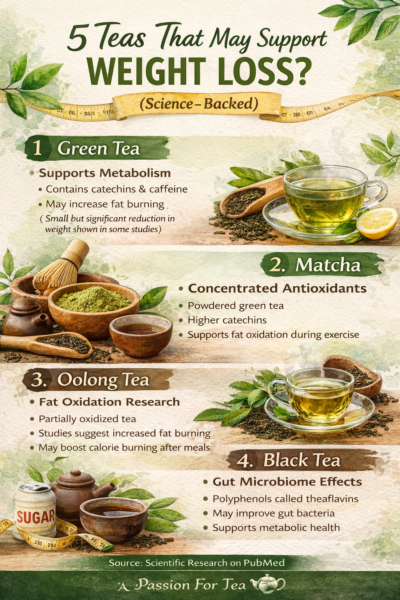
Among all teas, green tea has received the most scientific attention. Green tea contains a catechin called EGCG (epigallocatechin gallate), which researchers believe plays a role in fat metabolism. A meta-analysis of clinical trials found that green tea catechins can have a modest effect on weight loss and weight maintenance.
Other studies have shown that consuming green tea extract for about 12 weeks may reduce body weight and waist circumference in some individuals.
Researchers suggest these effects may occur because green tea can:
However, the weight loss observed in studies is usually small. Some clinical trials even found no significant difference between green tea and placebo after several weeks.
So while green tea may help slightly, it is not a standalone weight-loss solution.
Matcha: A Concentrated Form of Green Tea
Matcha is powdered green tea where you consume the entire leaf, rather than just the brewed infusion.
Because of this, matcha often contains:
- higher antioxidant levels
- higher catechin concentrations
- moderate caffeine
Researchers believe these compounds may increase fat oxidation during exercise and enhance thermogenesis (heat production in the body).
While matcha research is still developing, its chemical profile is similar to green tea — which means it may offer similar metabolic benefits.
If you are curious about the differences between these two teas, you may enjoy my article on matcha vs green tea differences.
Oolong Tea and Fat Metabolism
Oolong tea sits between green tea and black tea in the oxidation process.
Some studies suggest oolong tea may increase fat metabolism. In one controlled study, researchers observed that oolong tea increased fat oxidation by about 20% over a 24-hour period compared to caffeine alone.
Another study found that oolong tea may increase energy expenditure by roughly 10–20%, which could contribute to weight management.
These findings suggest oolong tea may support metabolism, though more large human studies are still needed.
🍃 Other Teas That May Support Metabolism
While green tea receives the most attention, other teas may also play a role in metabolic health.
Black Tea
Black tea contains polyphenols called theaflavins, which may influence gut bacteria and metabolism.
Pu-erh Tea
This fermented Chinese tea has been traditionally consumed after heavy meals and may help regulate lipid metabolism.
Herbal Teas
Herbal teas are technically tisanes rather than true tea, which I explain in my article on the difference between herbal tea and real tea.
While herbal teas may not directly burn fat, they can support healthy habits by replacing sugary drinks.
PubMed Studies on Benefits of Tea
- Tea and health: preventive and therapeutic usefulness in the elderly?
The Real Weight-Loss Benefit of Tea
One of the biggest benefits of tea is actually very simple.
Tea is:
- almost zero calories
- hydrating
- satisfying
When people replace soda, sugary coffee drinks, or juices with tea, they can significantly reduce daily calorie intake. Over time, that simple habit may contribute to weight control.
Tea can also support relaxation and stress reduction. Stress often influences eating habits, which is why many people enjoy teas that help with stress as part of a healthy lifestyle.
Tea Is a Supportive Habit — Not a Miracle CureLooking at all the research together, the conclusion is clear.
Tea may:
- slightly increase fat oxidation
- support metabolism
- help replace sugary drinks
But tea alone will not cause dramatic weight loss. Most researchers agree that the best results occur when tea is combined with:
- balanced nutrition
- regular exercise
- good sleep habits
- balanced nutrition
- regular exercise
- good sleep habits
When used this way, tea can be a healthy and enjoyable part of a weight-management lifestyle.
A Simple Tea Habit That Supports Wellness
One of my favorite tea rituals is simply enjoying a warm cup while relaxing at home — sometimes while working on puzzles or enjoying quiet moments. Sometimes when I can’t sleep at night I get up and sip a nice herbal (no caffeine) tea for a while. These relaxing tea rituals at home are part of what makes tea such a wonderful daily habit.
Whether your goal is wellness, relaxation, or simply enjoying good tea, a cup of tea is always a good place to start.
Key Takeaway
Scientific research suggests tea may have small but meaningful metabolic benefits, especially green tea and oolong tea. However, tea works best as part of an overall healthy lifestyle rather than as a quick weight-loss solution.
The best approach is simple:
Drink tea regularly, enjoy the ritual, and let it support healthy habits over time.
✅ Internal links included
- Matcha vs green tea article
- Herbal tea vs real tea article
- Stress tea article
- Puzzle tea ritual article
Where to purchase teas
Here are some of the teas I use which I purchase from The Republic of Tea, my favorite supplier:
- Oolong Tea Oolong is a traditional semi-oxidized Chinese tea produced through a process that includes withering the leaves under strong sun and allowing some oxidation to occur before curling and twisting. Most oolong teas, especially those of fine quality, involve unique tea plant cultivars that are exclusively used for particular varieties.
- Green Tea Green tea is a type of tea made from the leaves and buds of the Camellia sinensis that have not undergone the withering and oxidation process that creates oolong teas and black teas. Green tea originated in China in the late 1st millennium BC, and since then its production and manufacture has spread to other countries in the East.
- Matcha Tea Matcha tea has a unique flavor profile with a balance of umami, gentle bitterness, sweetness, and grassy freshness, often described as a harmony of earthy, sweet, and savory notes. Its texture is creamy and frothy when prepared well, offering a rich and satisfying mouth feel.
- Black Tea Black tea is a type of tea that is more oxidized than oolong, yellow, white, and green teas. Black tea is generally stronger in flavour than other teas. All five types are made from leaves of the shrub Camellia sinensis, though Camellia taliensis is also rarely used. Black tea retains its flavour for several years. Black tea contains caffeine, negligible micronutrients, and no calories.
- Pur ehr tea Pu’er or pu-erh[1] is a variety of fermented tea traditionally produced in Yunnan Province, China. Pu-erh tea is made from the leaves of the Yunnan tea plant Camellia sinensis var. assamica, which is a specific variety of tea plant that is native to Yunnan Province.
- Various herbal teas Herbal teas or herb teas, technically known as herbal infusions, and are less commonly called tisanes. They are beverages made from the infusion or decoction of any herbs, spices, or other plant material in water that is not derived from the tea plant (Camellia sinensis).
Medical Disclaimer
I am not a physician and as such I cannot diagnose or treat people, please consult with your physician about diet changes. – Shirley
PubMed Studies on the Benefits of Tea
PubMed is a free resource supporting the search and retrieval of biomedical and life sciences literature with the aim of improving health–both globally and personally.
PubMed contains more than 40 million citations and abstracts of biomedical literature. It does not include full text journal articles; however, links to the full text are often present when available from other sources, such as the publisher’s website or PubMed Central (PMC).
Available to the public online since 1996, PubMed was developed and is maintained by the National Center for Biotechnology Information (NCBI), at the U.S. National Library of Medicine (NLM), located at the National Institutes of Health (NIH).
Affiliate Links
This post contains affiliate links which, if clicked on and an item purchased, I receive a small commission with no extra cost to you. – Shirley
Comments
I enjoy receiving comments and questions from site visitors, you can leave yours below – Shirley